
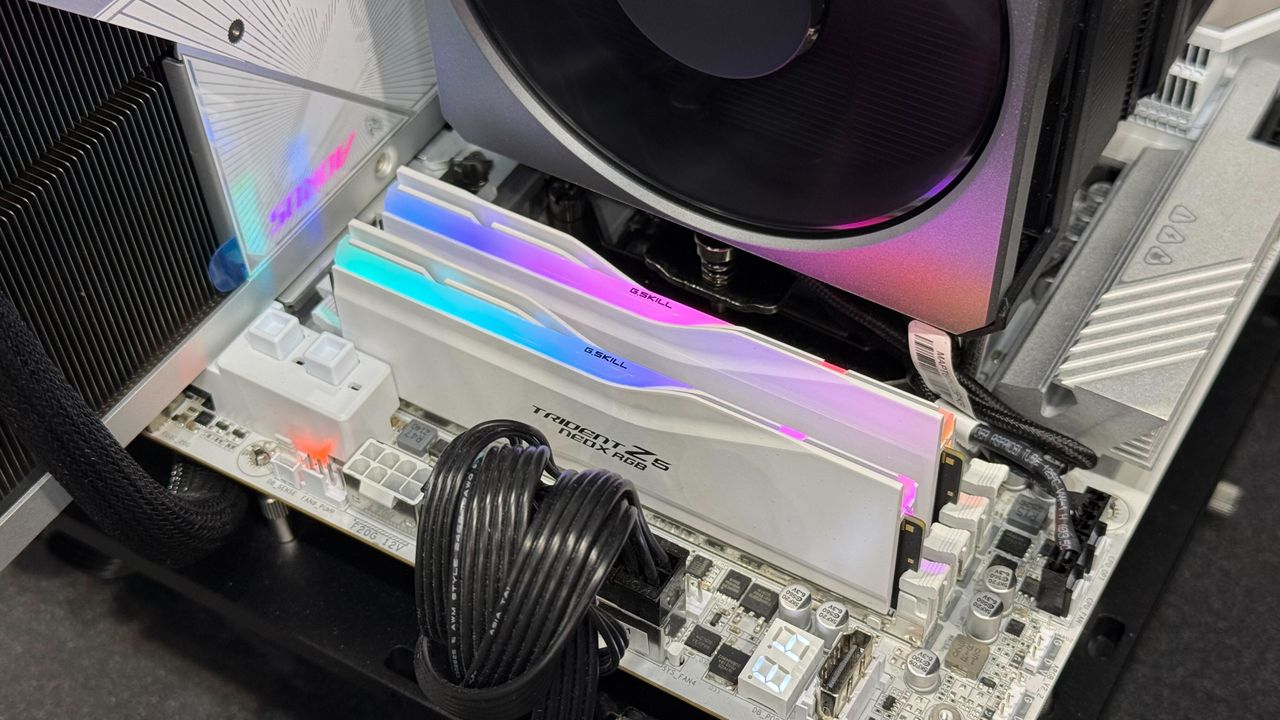
G.Skill's new AMD EXPO Ultra Low Latency (ULL) DDR5 memory kits have launched on retail markets, with a 32GB DDR5-6000 C26 kit priced at a significant $1,099. This pricing represents an 80% premium over comparable standard AMD EXPO memory, directly contradicting AMD's earlier statements that ULL kits would be "effectively the same price." The high cost reflects both specialized manufacturing for lower latencies and broader trends of increasing DDR5 memory prices driven by AI data center demand.
Premium Latency, Premium Price
\nAMD EXPO ULL (Extended Profiles for Overclocking Ultra Low Latency) memory kits, designed to offer enhanced performance for AMD Ryzen processors, are now available, but at a substantially higher cost than anticipated. A G.Skill Trident Z5 NeoX 32GB (2x16GB) DDR5-6000 CL26 kit is currently listed for $1,099.99 on Newegg.
\nContext of Rising Memory Costs
\nThe introduction of these high-priced ULL kits occurs amidst a challenging period for the broader DDR5 memory market. Industry analysts have noted a significant surge in DDR5 prices throughout 2025 and into 2026, primarily due to escalating demand from artificial intelligence (AI) data centers. Manufacturers are increasingly reallocating wafer capacity towards higher-margin High-Bandwidth Memory (HBM) used in AI accelerators, which in turn constrains the supply of conventional DDR5 DRAM. For instance, a 32GB DDR5-6000 kit that cost around $80 in mid-2025 reached approximately $432 by early 2026, an increase of over 400% in less than a year. This trend is expected to keep DDR5 profitability elevated throughout 2026, with significant price relief unlikely until late 2027. According to TrendForce, conventional DRAM contract prices rose roughly 93%–98% quarter over quarter in the first quarter of 2026.
\nThe ULL Premium Unpacked
\nAMD previously indicated that EXPO ULL memory kits would be "effectively the same price" as standard EXPO kits. However, the retail launch of G.Skill's Trident Z5 NeoX series reveals a different reality. A direct comparison shows the new ULL-optimized DDR5-6000 CL26 32GB kit priced at $1,099.99, while a standard G.Skill Trident Z5 Neo DDR5-6000 CL30 32GB kit is available for around $609.99. This represents an 80% premium for the Ultra Low Latency variant. The Trident Z5 NeoX series, available in black, glossy black, and white, aims to offer tighter timings and lower latencies for improved responsiveness. G.Skill has explained that the additional work involved in the stricter binning process for ULL modules contributes to their higher cost.
\n\"With AMD Expo technology featuring Ultra Low Latency, we are taking memory performance to the next level. This is all about optimizing for lower latency to deliver a more responsive gaming experience.\" — AMD Statement, Computex 2026\n
AMD EXPO ULL technology, introduced at Computex 2026, is designed to enhance DDR5 memory overclocking for gaming, promising up to 13% higher average FPS and 15% better 1% lows versus standard JEDEC memory. It allows memory makers more freedom to adjust sub-timings, which are then included in the memory's Serial Presence Detect (SPD) profile. This specialized tuning aims to reduce memory latency by 5 to 7 nanoseconds compared to regular DDR5-6000 kits.
\n- \n
- The G.Skill Trident Z5 NeoX DDR5-6000 C26 32GB kit operates at a consistent 1.35V, lower than the 1.40V or 1.45V often required by standard Trident Z5 Neo series modules. \n
- Lower DRAM voltages contribute to reduced power consumption and operating temperatures, potentially offering more headroom for further overclocking. \n
- AMD EXPO ULL is a premium addition to the EXPO program, not a broad replacement for non-ULL profiles, targeting demanding gamers and enthusiasts. \n
What This Means
\nFor professionals and informed tech enthusiasts, the launch of AMD EXPO ULL RAM at such a high price point signals a clear segmentation in the high-performance memory market. While the technical optimizations for ultra-low latency are genuine and can offer measurable performance benefits, particularly in CPU-bound gaming scenarios, the cost-to-performance ratio becomes a critical consideration. The substantial premium suggests that these kits are aimed at a niche audience willing to pay top dollar for every incremental performance gain, especially when coupled with the general upward trend in DDR5 pricing. It also highlights the ongoing impact of global memory supply dynamics, where specialized, high-margin products like HBM for AI are influencing the availability and pricing of consumer-grade DRAM.
\nKey Points
\n- \n
- AMD EXPO ULL memory kits, such as G.Skill's Trident Z5 NeoX, launched at $1,099.99 for a 32GB DDR5-6000 CL26 configuration. \n
- This pricing represents an 80% premium over comparable standard AMD EXPO DDR5-6000 CL30 32GB kits. \n
- AMD had previously stated that EXPO ULL kits would be "effectively the same price" as standard EXPO memory. \n
- The higher cost is partly attributed to the specialized manufacturing and stricter binning process required for ultra-low latency modules. \n
- The overall DDR5 market is experiencing significant price increases due to demand from AI data centers and a shift in manufacturing capacity to HBM. \n
The Bottom Line
\nThe arrival of AMD EXPO ULL RAM at a premium price point of $1,099.99 underscores the growing cost of cutting-edge memory technology. While these kits promise superior low-latency performance for AMD Ryzen systems, the significant price hike challenges earlier expectations. Consumers should carefully weigh the performance benefits against the substantial investment, especially given the broader market trends of elevated DDR5 pricing driven by AI demand, which analysts expect to continue through 2026.
\n