
The open-source Git project released version 2.55 on June 29, 2026, introducing significant performance improvements for large repositories through enhanced incremental multi-pack indexes and enabling parallel execution for compatible hook scripts. This update also marks a notable step towards memory safety by making Rust support enabled by default for source builds.
Git 2.55 Arrives with Key Optimizations
The Git project recently unveiled its 2.55 release, bringing a suite of features and bug fixes from a diverse group of over 100 contributors, including 33 new to the project. This update focuses on improving efficiency and developer experience, particularly for managing extensive codebases.
Underlying Improvements for Large Repositories
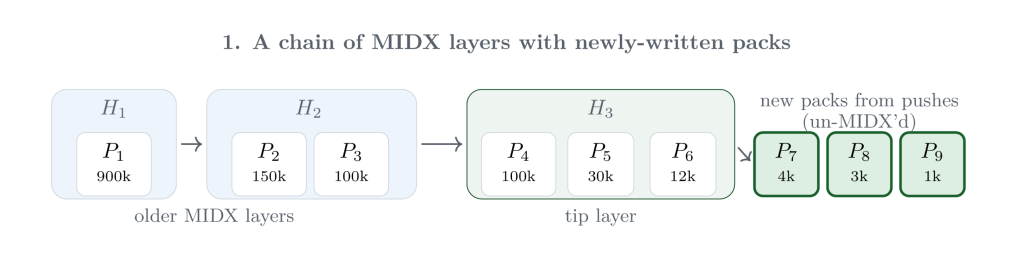
A core enhancement in Git 2.55 is the continued development of incremental multi-pack indexes (MIDX), a feature initially introduced in Git 2.47. Git stores repository data as individual objects—commits, trees, and blobs—often compressed into packfiles, each with a corresponding index to facilitate quick object location. However, large repositories can accumulate numerous packfiles over time due to various operations like fetches and maintenance tasks. A multi-pack index provides a single, unified index across many packfiles, streamlining object lookups. The incremental MIDX format allows this index to be stored as a chain of layers, significantly reducing the overhead associated with updating a single, massive index file, which previously required rewriting the entire structure for even minor changes. This approach is crucial for optimizing Git's repository maintenance strategies, especially for platforms like GitHub.
Accelerating Developer Workflows and System Integration
Beyond storage optimizations, Git 2.55 introduces features directly impacting developer workflows and system integration. One notable improvement is the ability to run compatible Git hook scripts in parallel. Developers can configure independent pre-commit hooks, for instance, for linting and unit tests, to execute concurrently, thereby saving time. The number of concurrent jobs can be controlled globally or per event.
"The open source Git project just released Git 2.55 with features and bug fixes from over 100 contributors, 33 of them new." — Taylor Blau, Principal Software Engineer, GitHub
Further performance gains come from optimized reachability bitmap generation, which can now be significantly faster. Benchmarks from the patch series indicate that this optimization reduced bitmap generation time in one large repository from approximately 612 seconds to about 294 seconds. Additionally, the built-in fsmonitor daemon, previously available only on macOS and Windows, now supports Linux systems, utilizing inotify for efficient file system monitoring.
- Parallel Hook Execution: Allows multiple compatible Git hooks to run simultaneously, improving pre-commit and other workflow stages.
- Faster Reachability Bitmaps: Optimizations in Git 2.55 have nearly halved the time required for generating reachability bitmaps in large repositories.
- Linux fsmonitor Support: The Git file system monitor daemon now extends support to Linux, enhancing performance for repositories on that platform.
- Default Rust Support: Git 2.55-rc0, released on June 11, 2026, enabled Rust support by default, aiming to strengthen memory safety and setting the stage for Git 3.0.
What This Means
For professionals managing large-scale software projects, Git 2.55's advancements translate into tangible efficiency gains. The incremental MIDX improvements directly address the performance bottlenecks often encountered in massive repositories, making routine maintenance and object lookups considerably faster. The ability to run hooks in parallel streamlines continuous integration and development pipelines, allowing for quicker feedback cycles. The default inclusion of Rust support underscores a broader industry trend towards memory-safe languages, indicating a future direction for Git's core development that prioritizes security and reliability. This release demonstrates the Git project's ongoing commitment to scalability and developer productivity.
Key Points
- Git 2.55 was released on June 29, 2026, with contributions from over 100 developers, 33 of whom were new.
- Enhanced incremental multi-pack indexes improve performance for large repositories by reducing update costs.
- The release enables parallel execution of compatible Git hook scripts, speeding up development workflows.
- Rust support is now enabled by default in Git 2.55, emphasizing a move towards memory-safe programming.
- Reachability bitmap generation has been optimized, reducing processing time in large repositories by over 50%.
The Bottom Line
Git 2.55 delivers crucial performance and efficiency upgrades, particularly beneficial for large-scale development environments. The advancements in incremental multi-pack indexes and parallel hook execution directly address common pain points in repository management and CI/CD pipelines. As the project continues its integration of Rust, developers can anticipate a more robust and secure future for the ubiquitous version control system. These ongoing improvements solidify Git's position as a foundational tool for modern software development.