
GitHub has introduced Qubot, an internal data analytics agent powered by GitHub Copilot, designed to empower its employees to query complex internal data using natural language. Announced on June 19, 2026, this development aims to democratize access to data and insights across product and engineering teams, tackling persistent challenges in achieving truly self-serve analytics. Qubot functions as an exploratory tool, providing rapid answers to specific data questions without requiring specialized data analyst support.
Democratizing Data Access at GitHub with Qubot
GitHub has officially rolled out Qubot, an artificial intelligence (AI) powered agent that enables employees to interact with the company's extensive data warehouse using everyday language. This innovative tool, detailed by Matteo Vasirani and Cynthia Joseph, addresses a long-standing industry challenge: making data and insights genuinely accessible to all teams without requiring deep technical knowledge or constant support from data analysts.
The Evolution of Self-Serve Analytics
For decades, large data and analytics organizations have grappled with providing self-serve access to their vast datasets, a problem that AI is now beginning to credibly solve. At GitHub's operational scale, offering dedicated analytics support to numerous product teams proves challenging, often leaving individual teams to navigate complex data models independently. Qubot emerges as a solution, allowing any GitHub employee, or 'Hubber,' to ask questions about any data model in GitHub's data warehouse and receive answers within seconds. This approach aligns with the broader industry trend of natural language processing (NLP) tools that translate plain-language queries into structured database commands, reducing the need for specialized coding skills.
Inside Qubot's Architecture and Capabilities
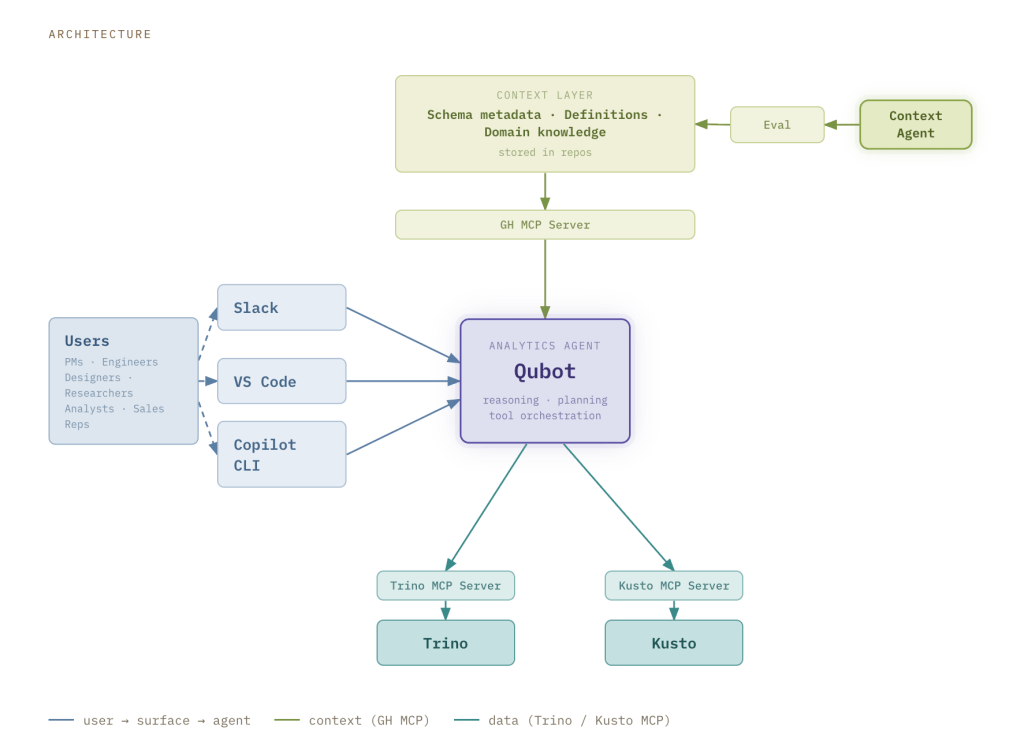
Qubot is built upon a three-component architecture: a user interface, a context layer, and a query engine. The agent is accessible through various platforms, including Slack, Visual Studio Code (VS Code), and the Copilot Command Line Interface (CLI), integrating seamlessly into existing developer workflows. Matteo Vasirani, a staff manager of software engineering leading product analytics and data science at GitHub, along with Cynthia Joseph, a senior product manager for the Data team, highlighted Qubot's design for exploratory questions rather than as a replacement for traditional reporting tools or dashboards.
"Qubot is not a reporting tool or a dashboard replacement. Instead, it’s intended for exploratory questions like ‘Which cohort of users has the highest retention on this feature?’ or ‘What product contributed to move this metric the most last week?’" — Matteo Vasirani & Cynthia Joseph, GitHub Blog
The system boasts zero maintenance costs and assists teams in quickly familiarizing themselves with unfamiliar datasets. Its query engine connects to both Kusto and Trino, GitHub's primary query engines, via an MCP server. Qubot intelligently defaults to Kusto for fast, exploratory queries on recent event data and automatically switches to Trino for more complex joins and historical analysis, abstracting this complexity from the user. The context layer is continually enriched with knowledge from multiple repositories, primarily utilizing Markdown for documentation, and is managed by a dedicated context agent that ingests and normalizes information into a structured format.
- Natural Language Interaction: Employees can ask data questions in plain English, eliminating the need for SQL knowledge.
- Rapid Insights: Qubot provides answers to complex data queries within seconds.
- Exploratory Focus: Designed for ad-hoc investigations rather than static reports.
- Seamless Integration: Available across Slack, VS Code, and the Copilot CLI.
- Intelligent Query Routing: Automatically selects the optimal query engine (Kusto or Trino) based on the question's complexity.
What This Means
The introduction of Qubot signifies a significant step in making enterprise data more accessible and actionable for a broader range of employees. For developers and product professionals, this means a reduced dependency on specialized data analysts for routine or exploratory data questions, potentially accelerating decision-making processes. It also highlights the growing maturity of AI-powered agents, particularly those leveraging large language models like GitHub Copilot, in transforming internal business operations beyond traditional code generation. This shift allows data and analytics teams to focus on more strategic initiatives, while operational teams gain immediate access to the insights they need.
Key Points
- GitHub launched Qubot, an internal AI-powered analytics agent, on June 19, 2026.
- Qubot enables GitHub employees to ask data questions in plain language, powered by GitHub Copilot.
- The agent is accessible via Slack, Visual Studio Code, and the Copilot CLI.
- It utilizes Kusto and Trino query engines, automatically selecting the appropriate one for the task.
- Matteo Vasirani and Cynthia Joseph were key contributors to Qubot's development and announcement.
The Bottom Line
GitHub's Qubot represents a practical application of AI to solve a pervasive organizational challenge: bridging the gap between vast data resources and the need for immediate, self-serve insights. By empowering employees to interact with data using natural language, GitHub is setting a precedent for how large enterprises can democratize data access and foster a more data-driven culture. Professionals should monitor how this internal tool evolves and its impact on GitHub's operational efficiency, as it could signal future trends for enterprise AI adoption in data analytics.