
Back to Home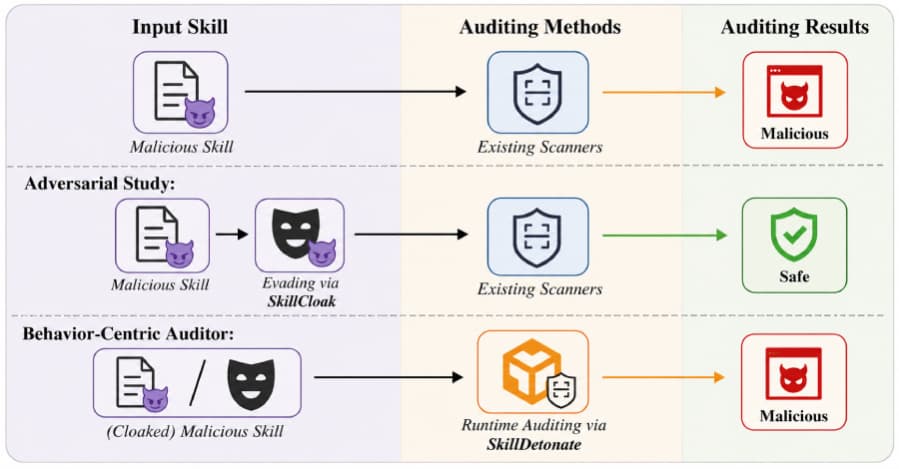
SkillCloak Lets Malicious AI Agent Skills Evade Static Scanners with Self-Extracting Packing
T
Techpivo News
·2 min read·0 views
SkillCloak Lets Malicious AI Agent Skills Evade Static Scanners with Self-Extracting Packing Swati Khandelwal Jul 06, 2026 AI Security / Threat Detection Scanners meant to catch malicious add-on "skills" for AI coding agents can be fooled by a few simple changes that leave the malware working, according to a new study from researchers at the Hong Kong University of Science and Technology. Their strongest trick slipped past every scanner tested more than 90% of the time, and the same team built a runtime checker that catches most of the disguised skills the scanners miss. Skills are small packages, usually a Markdown instruction file plus a few scripts, that agents such as Claude Code, OpenAI Codex, and OpenClaw load to pick up a new capability. Because a skill is just a bundle of files, the same one can run across different agents. And it runs with the agent's own access: your files, your terminal, your saved passwords. A bad one can steal credentials, copy source code, or install a backdoor. Most of what a public marketplace lists is uploaded by strangers with little vetting. The main defense so far has been the skill scanner, which reads a skill's files before you install it and blocks anything that looks dangerous. The paper, titled " Cloak and Detonate ," tests whether that actually holds up. It does not. Beating scanners isn't new, though. The Hacker News has covered researchers pushing a fake skill past every scanner it faced , which by the firm's own count reached tens of thousands of agents. What this paper adds is a way to do it systematically, at scale, and a defense that still works when it does. How the disguised skills get through The researchers' tool, SKILLCLOAK , rewrites a malicious skill to look clean while behaving exactly the same. It works two ways. The lighter one rewrites the give-away bytes a scanner keys on, using the paper's own operators: swap a character for a look-alike from another alphabet, or split